Lesson 1: Introduction to Workplace Health & Safety
4 minutes
Course Overview Spotting a hazard is only the beginning. The next question is what you do with that information. A …
Spotting a hazard is only the beginning. The next question is what you do with that information.
A loose cable, an unguarded piece of equipment, an incorrectly stored chemical or missing protective equipment can all create risk in the workplace. Effective health and safety depends on being able to recognise these situations, understand the level of risk involved, and take appropriate action.
Health & Safety at Work – Level 2 develops workplace safety knowledge beyond basic awareness, with a stronger focus on hazard identification, risk assessment, control measures, PPE and emergency response. Learners explore how hazards can affect different working environments and how risks can be identified, assessed and controlled.
The course also looks at the responsibilities of employers and employees, the selection and correct use of personal protective equipment, and appropriate responses to workplace incidents such as fires, chemical spills, medical emergencies, slips, trips and falls.
For employees developing their workplace knowledge, learners progressing from introductory safety training, or those whose roles involve greater awareness of workplace risks, this course provides a practical foundation for making informed and safer decisions at work.
This course is suitable for employees, workers, supervisors, team members, and anyone who wants to develop a stronger understanding of workplace health and safety. It can be particularly useful for people working in environments where recognising hazards, using PPE or responding to workplace risks forms part of their responsibilities.
Health & Safety at Work – Level 1 is recommended before starting this Level 2 course, as Level 2 builds on foundational workplace health and safety knowledge.
By completing Health & Safety at Work – Level 2, learners should be able to:
Workplace risks rarely announce themselves as risks. They often appear as ordinary parts of the working environment — until someone recognises that something is wrong.
A damaged piece of equipment, an exposed cable, an incorrectly stored substance or an unsuitable workstation may each create a different type of hazard. Knowing how to recognise these hazards gives employees a stronger starting point for deciding what needs attention and what action may be appropriate.
Level 2 also moves beyond simply identifying problems. Risk assessment helps turn observation into structured decision-making. Learners develop an understanding of how hazards can be assessed, how appropriate controls can be considered, and why risks should be addressed rather than simply noticed.
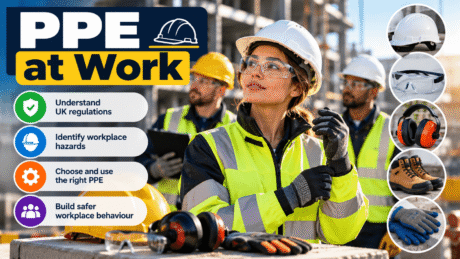
Personal protective equipment is another important part of workplace safety. PPE is not simply something to put on when entering a particular work area. Choosing the appropriate protection, checking its condition, fitting it correctly and understanding how it should be removed, stored or disposed of all contribute to its effective use.
The course also prepares learners to think about what happens when prevention does not go according to plan. Fires, chemical spills, medical emergencies, slips, trips and falls can require a prompt and appropriate initial response. Understanding workplace procedures, seeking assistance and recognising the limits of personal training are important parts of responding safely.
The UK workplace context is also addressed through an introduction to responsibilities under the Health and Safety at Work etc. Act 1974, helping learners understand the roles employers and employees have in maintaining safer working environments.
For anyone who has already encountered basic workplace safety concepts, this Level 2 training provides an opportunity to develop that knowledge into a more structured understanding of risk, controls, PPE and emergency response.
Health & Safety at Work – Level 1 is recommended before starting this Level 2 course, as Level 2 builds on foundational workplace health and safety knowledge.
Health and safety knowledge can add practical value to a wide range of workplace roles, particularly where employees are expected to recognise hazards, follow control measures, use PPE or respond appropriately to unsafe situations.
This course can be relevant to people working in or considering roles across areas such as:
The course can also be a useful starting point for further training in areas such as risk assessment, fire safety, first aid, manual handling, hazardous substances and industry-specific health and safety.
Complete your training and celebrate your achievement with a Course Completion Certificate from All Skill Academy.
Your certificate provides a simple way to recognise your learning and show that you have completed the course.
It is workplace health and safety training that develops knowledge of hazard identification, risk assessment, control measures, PPE and incident and emergency response.
It is suitable for employees, workers, supervisors, team members and learners who want to develop their understanding of workplace health and safety beyond basic awareness.
A hazard is something that has the potential to cause harm, while risk relates to the possibility of that harm occurring and the level of risk associated with it.
Yes. Learners explore the main stages of identifying hazards, assessing risks and considering appropriate measures to eliminate, reduce or control those risks.
The course covers different types of PPE and their uses, along with appropriate selection, inspection, fitting, use, removal, storage and disposal.
Yes. It addresses appropriate initial responses to situations including fires, chemical spills, medical emergencies, slips, trips and falls, while emphasising the importance of following workplace procedures and seeking appropriate assistance.
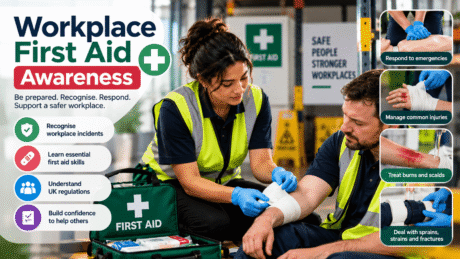
No. The course introduces basic first-aid principles as part of emergency response but does not establish a standalone first-aid qualification.
Yes. The course is framed around the UK workplace context and introduces employer and employee responsibilities, including reference to the Health and Safety at Work etc. Act 1974.
Yes. The knowledge gained can provide a foundation for further learning in areas such as risk assessment, fire safety, first aid, manual handling, hazardous substances and other workplace-specific health and safety subjects.